COCO₂

A student-led project to reduce air pollution

A low-cost solution for cleaner rides and clearer skies.

A low-cost solution for cleaner rides and clearer skies.

Designed by a team of high school innovators, COCO₂ is a snap-on exhaust filter made from sustainably sourced coconut biochar that reduces CO₂ and unburnt hydrocarbon emissions from motorcycles. Paired with a smart AI-powered app, COCO₂ monitors engine vibrations and temperature to detect idling and encourage more efficient, eco-friendly riding habits. By combining natural filtration with intelligent monitoring, COCO₂ makes everyday transportation cleaner, smarter, and more sustainable.

01Our Mission

To make clean air accessible by empowering everyday riders with affordable, nature-based technology that reduces pollution at its source.

02Our Vision

A future where growing cities can thrive without sacrificing the health of their people. Where innovation led by youth transforms pollution into an opportunity for sustainable change.

03Our Story

Our team was formed after experiencing first-hand how urban air pollution affects lives in developing countries, specifically Indonesia. We observed a clear contradiction: motorcycles sustain lives and are the backbone of transport for low-income families, yet significantly degrade air quality and public health. This shared reality brought our team from National High together to design a solution for Southeast Asia that works with existing vehicles, rather than pushing low-income communities toward higher-cost alternatives they may not afford.

COCO₂ is more than a product. It's our way of proving that youth-led innovation, rooted in local realities, can create global impact one ride, one breath, and one city at a time.

The Problem

Motorcycles are the backbone of Southeast Asia's mobility, providing affordable transportation for over 235 million riders. However, their widespread use contributes significantly to urban air pollution, accounting for up to 60% of transport-related emissions in many cities.

With limited access to clean, low-cost emission solutions, worsening air quality has been linked to reduced life expectancy by nearly two years, placing long-term strain on public health systems and economic productivity.

Our Solution

COCO₂ is a snap-on exhaust filter made from coconut biochar that helps reduce CO₂ and unburnt hydrocarbon emissions from motorcycles. Paired with a smart AI-powered app, COCO₂ monitors engine vibrations and temperature to detect excessive idling and encourage more efficient, eco-friendly riding habits.

Our Unique Approach

Unlike expensive, complex emission-control alternatives, COCO₂ is a piezo-powered, snap-on exhaust filter made from coconut waste–derived biochar, designed to be both affordable and easy to adopt. Integrated with an AI-powered mobile app, COCO₂ tracks engine behavior to estimate fuel efficiency and emission reduction in real time. By combining biochar-based filtration with behavioral insights that discourage unnecessary idling, COCO₂ reduces emissions both chemically at the source and socially through smarter riding habits.

World's First Low-Cost Accessible Filter

COCO₂ is the world's first truly affordable and accessible motorcycle emission reduction technology designed for everyday riders in developing nations.

WHO Statement

"The World Health Organization has identified air pollution from road transport as one of the leading environmental health risks globally, with the highest exposure occurring in cities where motorcycles and two-wheelers are the dominant mode of transport. WHO emphasizes that immediate, cost-effective interventions targeting existing vehicles are essential to reduce health impacts, particularly in low- and middle-income countries."

— World Health Organization (WHO)

Our Design & Plans

COCO₂ uses a compact two-zone design with distinct hot and cold zones for efficient exhaust treatment. A honeycomb, replaceable biochar filter cartridge features a spider-clam-inspired locking mechanism for quick replacement and a secure, universal fit. Integrated temperature and vibration sensors in the hot zone collect real-time engine data, enabling live feedback through the COCO₂ app to promote more efficient and sustainable riding.

Full Device (Overall Design)
Two-zone architecture with a replaceable biochar filter and integrated sensors, designed for universal fit and easy maintenance.
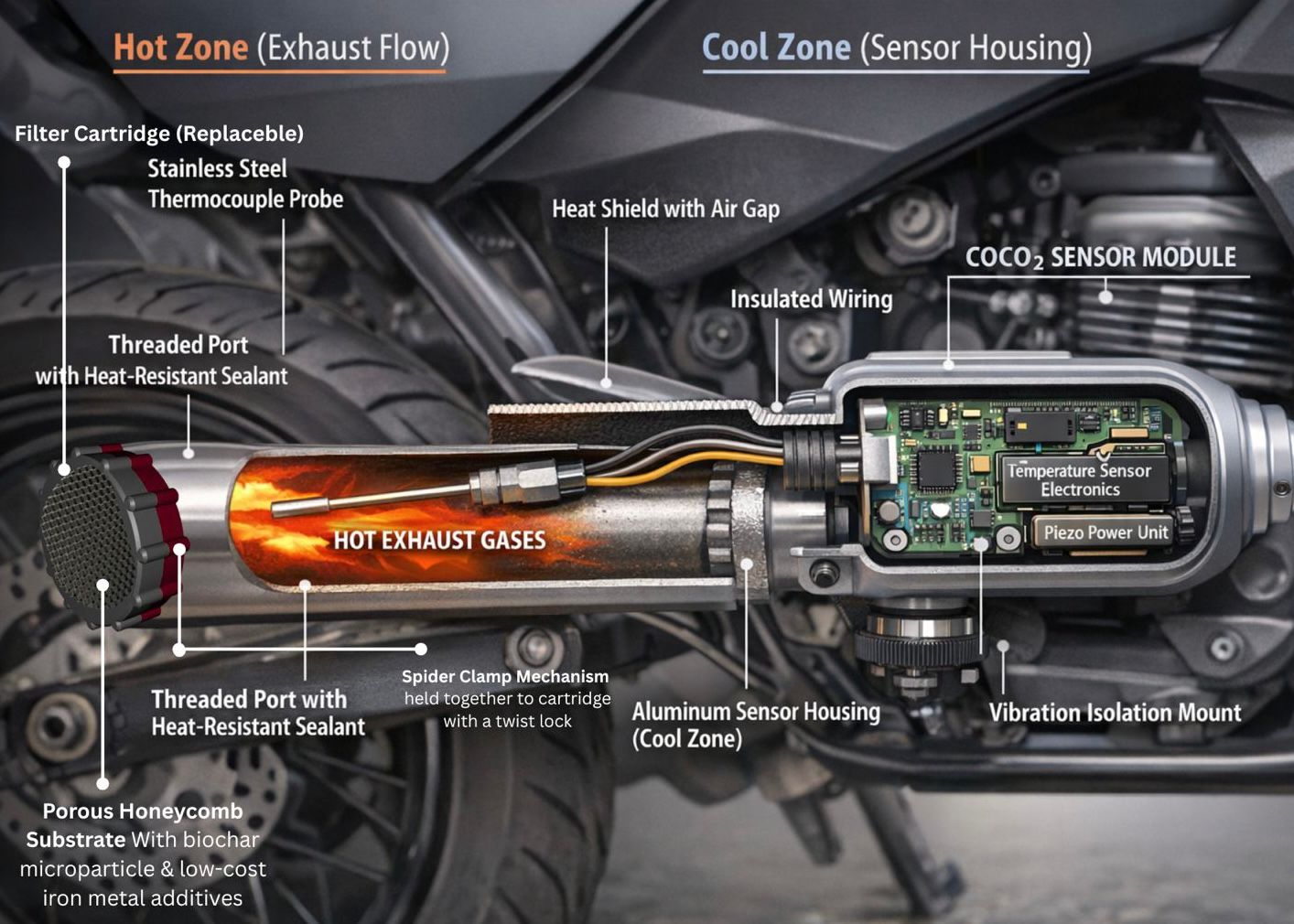
COCO₂ Filter Design
Hot Zone Close-up
Honeycomb structure coated with iron and upcycled coconut biochar, featuring a twist-lock mechanism and spring steel arms for tool-light installation and high vibration resistance.
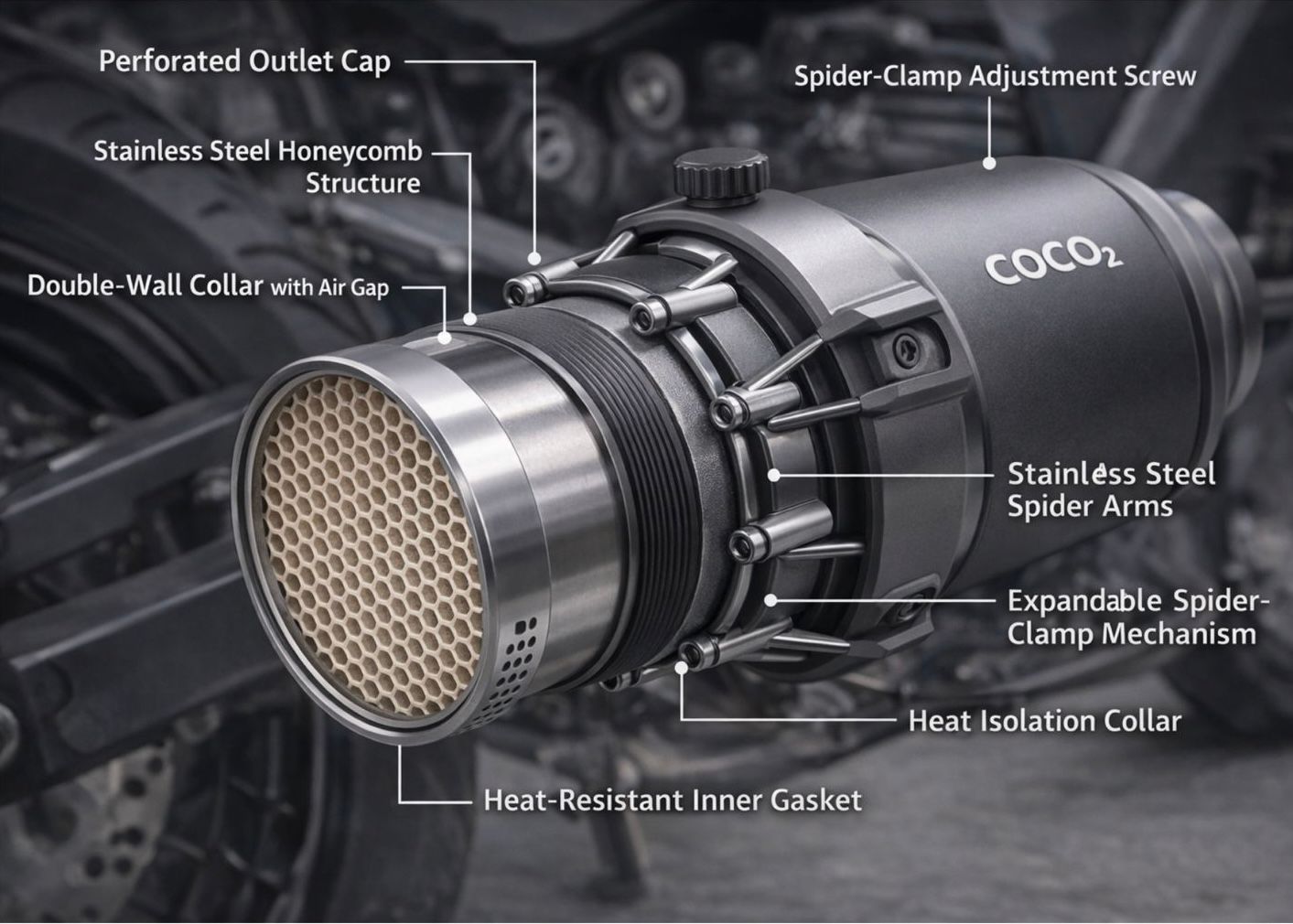
Hot-zone Close-up
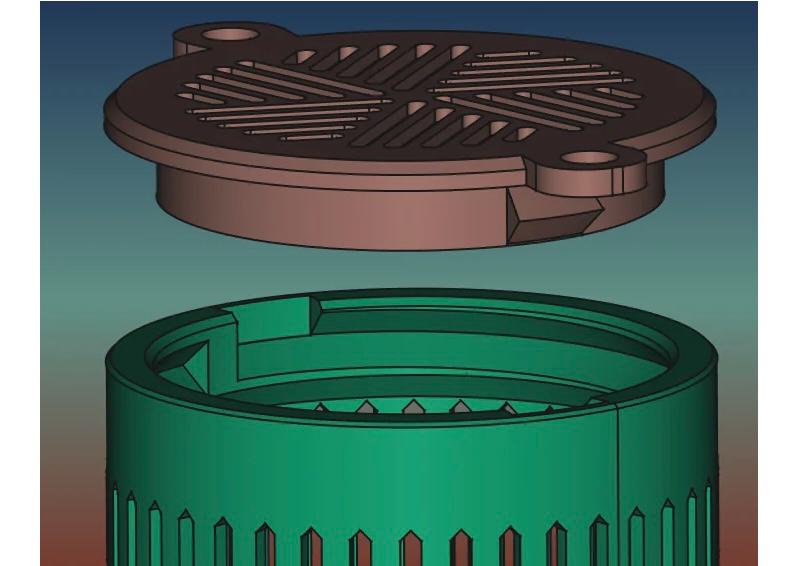
Snap-on system
A simple twist-lock system enables quick, tool-free filter swaps while ensuring a tight, secure fit even under constant engine vibration.
Snap-on system
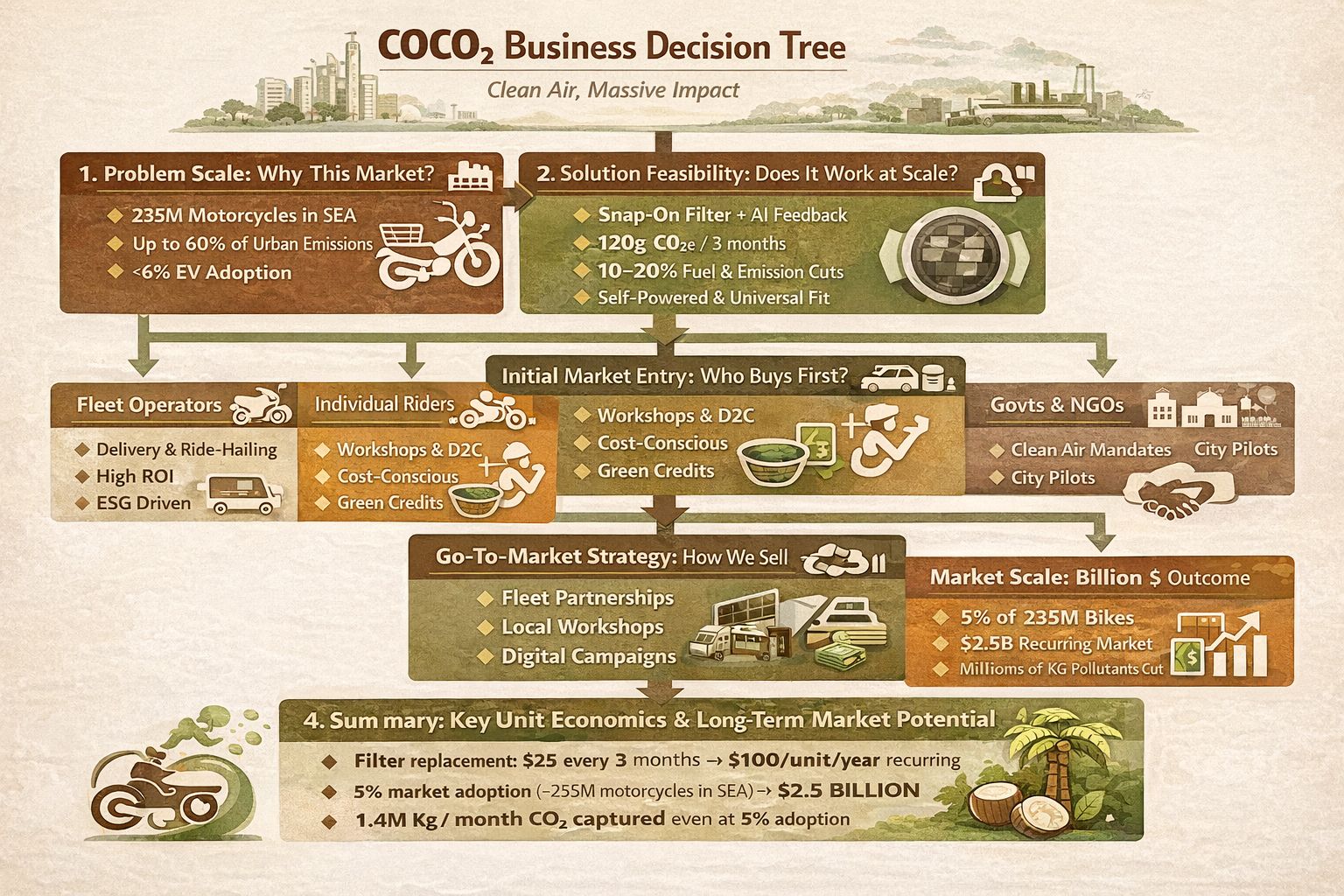
Decision Tree
From identifying the problem to validating solutions, assessing feasibility, exploring market opportunities, and planning go-to-market strategies.
COCO₂ Decision Tree
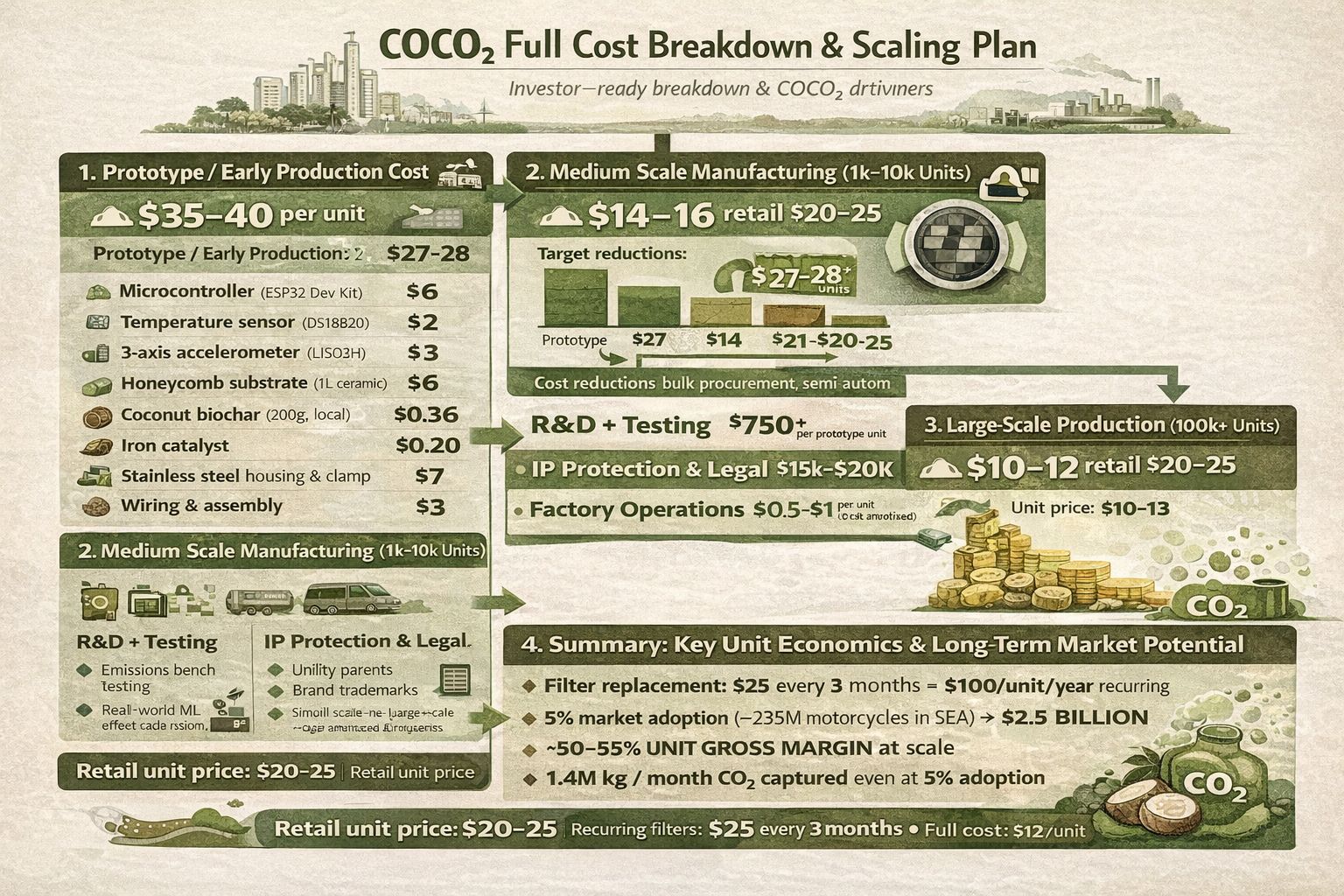
Cost Breakdown
Transparent overview of production, installation, and operational expenses for an affordable, sustainable solution.
COCO₂ Cost Breakdown

Our User App

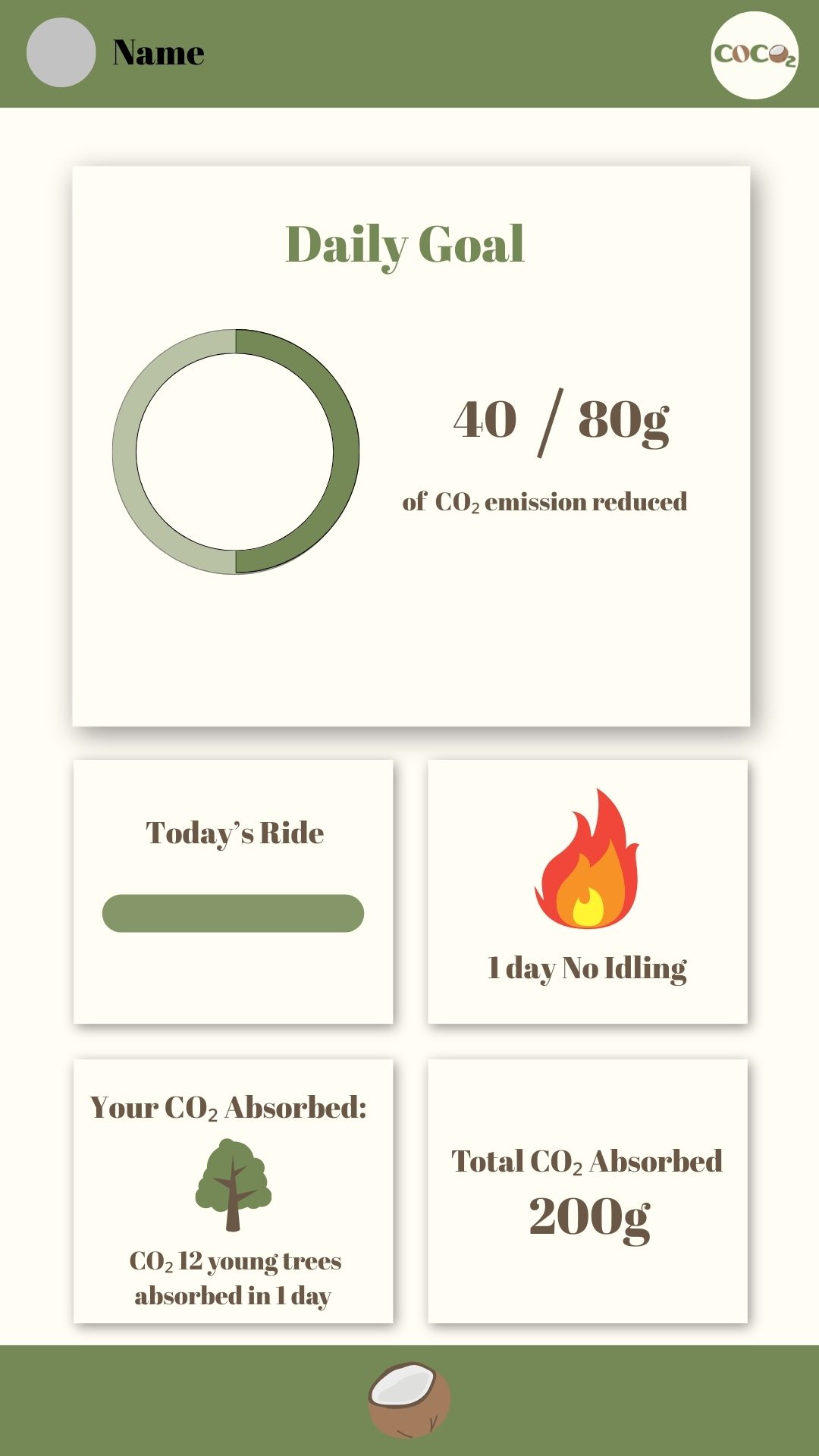
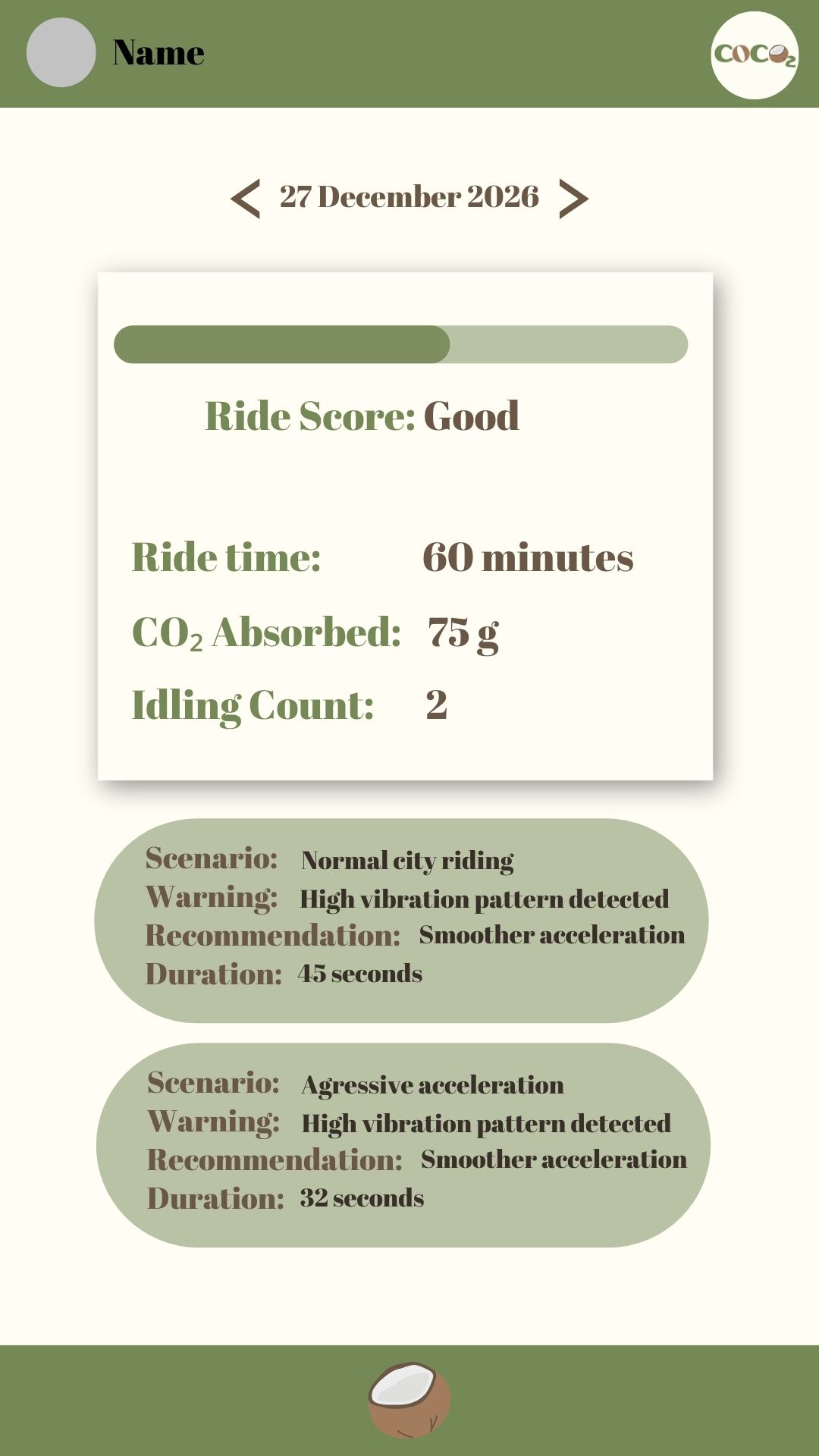
Our companion app turns your coconut biochar system into a fun, interactive experience. See exactly how much CO₂ you've saved, visualized in real-life equivalents like trees planted. The app also tracks idling behaviour so users can cut unnecessary emissions effortlessly. It's designed to make sustainability engaging, measurable, and easy for everyone.

Development Stages

1

White Paper

Our white paper integrates statistical data and existing research to assess the feasibility of COCO₂ through establishing a theoretical model predicting significant per-unit emission reductions based on: material & structure feasibility (Biochar-Metal Composite in Honeycomb Configuration), System Integration and Energy Autonomy, Derived Impact (Monthly Capture Potential) and Urban Scaling which are all essential towards validating our innovation and our ability to become a sustainable, data driven business.

2

Technology Research & Validation

We conducted an extensive literature review on coconut biochar absorption properties in terms of its efficiency in capturing unburnt hydrocarbons and carbon dioxide. Indicating each COCO₂ filter theoretically can capture up to 16 grams of CO₂ at saturation, which is in line with adsorption limits for low-cost biochar materials at this scale. Proving the potential of our innovation to provide 160 metric tons of CO₂ captured per replacement cycle with only 1-2% of Asia's motorcyclists adopting COCO₂.

3

Filter Design & Rapid Prototyping

Using Autodesk Fusion 360 we designed a modular twist-lock mounting mechanism, inspired by bayonet-style snap fittings, to allow fast, tool-free filter replacement for our users. A spider-style self-centering clamp allows the system to expand and securely fit a range of motorcycle exhaust diameters to prevent unintended detachment from motorcycle vibration / movement. Multiple 3D-printed iterations were produced to validate fit, alignment, and ease of installation.

4

AI Software & Hardware Selection

We selected low-cost MEMS accelerometer vibration sensors and temperature sensors to minimize unit cost while capturing real-world motorcycle operating data. Using simulated placeholder data, we developed a lightweight machine learning model with real-time rider feedback & notifications to validate feasibility of AI-enabled emission reduction at scale, and are currently progressing toward a deep learning model as larger datasets become available.

5

System Integration Feasibility

We validated real-world system integration by testing the Bluetooth Low Energy transmission of vibration and temperature data from MEMS-based sensors to a mobile device. These tests confirmed stable connectivity, real-time data transfer, and compatibility with low-power microcontroller platforms under operating conditions.

6

Market & Business Model

We assessed market viability across individual riders and commercial fleets within the 200+ million motorcycle market in Asia. By maintaining a unit cost approximately 70% lower than complex retrofit solutions, the model supports rapid adoption at scale. A recurring revenue structure based on $25 filter replacements every 3 months yields a projected $2.5B annual service market at 5% penetration.

Initial Phase Completion

The initial phase is complete with successful laboratory validation, 3D-printed mechanical prototyping, sensor connectivity testing, and development of a real-time machine learning feedback system. Further real-world testing is needed to fully characterize on-road performance.

Next Phase

The next phase focuses on on-road testing with moving motorcycles, quantitative measurement of CO₂ and hydrocarbon capture efficiency, refinement of the AI system using real-world data, mobile app development, and pilot deployments with riders and fleet partners.

Why COCO₂ Matters

8.1M

Global deaths linked to air pollution annually, the second leading risk factor for death worldwide. UNICEF

90%+

Of people breathe unsafe air levels daily. stateofglobalair.org

87-94%

Of vehicle emissions in motorcycle-dominant cities come from motorcycles magnifying urban smog and health risks.Wikipedia

Our Team

Team Member 1Photo'">

Kiera Yasa

Co-founder

National High Jakarta School

kierayasa@gmail.com
Team Member 2Photo'">

Zoe Hidayat

Team Leader

National High Jakarta School

zoehidayat.28@gmail.com
Team Member 3Photo'">

Alika Tirtawisata

Co-founder

National High Jakarta School

alika.tirtawisata@gmail.com
Team Member 4Photo'">

Jayden Leo

Co-founder

National High Jakarta School

jaydenleo2009@gmail.com
Team Member 5Photo'">

Amadeo Dave

Co-founder

National High Jakarta School

amadeo.dave.rn@gmail.com